The U.S. military struck three Iranian oil tankers Saturday after the regime launched ballistic missiles at two American warships — a direct blow to Iran’s multibillion-dollar sanctions-evasion network.
The military action represents one of the most significant direct strikes against Iranian economic assets in recent years, targeting infrastructure that has long been central to Tehran’s ability to circumvent international sanctions and fund its military operations across the Middle East.
U.S. Central Command (CENTCOM) forces disabled three Islamic Revolutionary Guard Corps (IRGC) oil tankers following the IRGC’s unprovoked attack on an American aircraft carrier and guided-missile destroyer on patrol, according to a CENTCOM press release.
— U.S. Central Command (@CENTCOM) September 5, 2026
No U.S. personnel were harmed as the two Navy ships evaded the Iranian regime’s ballistic missile attack.
The successful evasion by American forces prevented what could have been a catastrophic escalation, while the proportional response targeting Iran’s economic infrastructure rather than military personnel signals a carefully calibrated strategy to impose costs without triggering broader regional conflict.
“Let the message to the IRGC be clear: If you shoot at two of our ships, we will impose an even higher economic cost — taking out three of yours. We will not hesitate to defend American forces, and if necessary, destroy Iran’s limited and exposed oil fleet.”
CENTCOM’s commander, Admiral Brad Cooper, delivered that message in the press release — a clear warning to Tehran that attacks on American forces carry a steep price.
The “three-for-two” calculus outlined by Admiral Cooper establishes a new deterrence framework that explicitly links Iranian aggression to economic consequences, moving beyond traditional military-to-military responses and instead targeting the financial lifelines that sustain the IRGC’s regional activities.
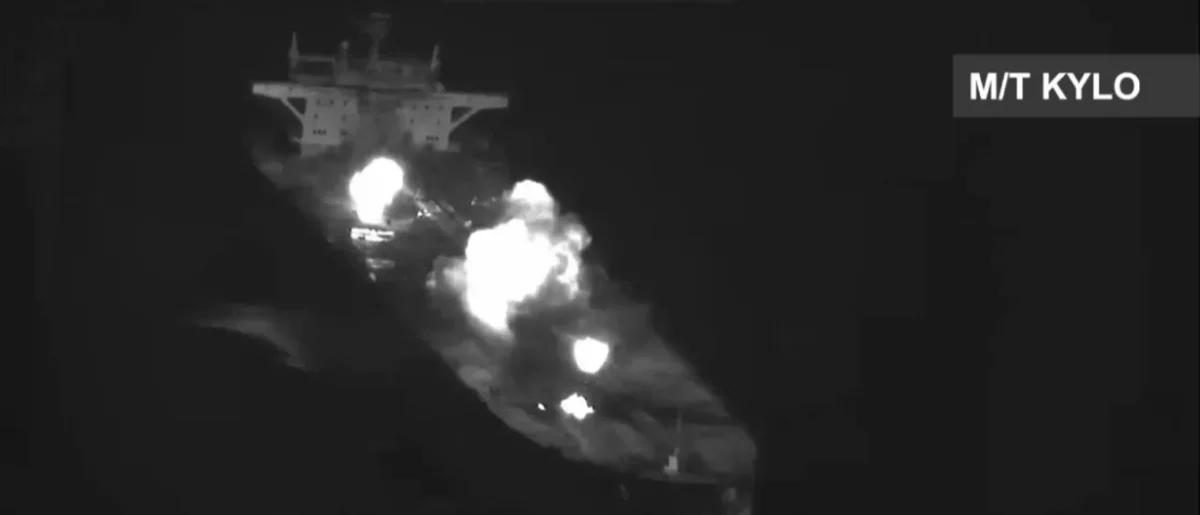
The three targeted IRGC oil tankers were identified as the M/T Downey near Kharg Island, M/T Stark 1 near the Iranian city of Jask, and M/T Kylo in the Gulf of Oman. They were part of a “multibillion-dollar shadow network that funds the IRGC and its regional proxies,” according to CENTCOM.
The geographic spread of the strikes — from Kharg Island in the northern Persian Gulf to Jask on Iran’s southeastern coast to the strategic Gulf of Oman — demonstrates both the reach of U.S. military capabilities and the vulnerability of Iran’s dispersed maritime oil infrastructure. These shadow fleet vessels have long operated by turning off transponders, using false flags, and conducting ship-to-ship transfers to evade detection and sanctions enforcement.
The strikes came just one day after the U.S. Department of the Treasury sanctioned a Turkish bank for allegedly providing Iran’s shadow network banking access amid Operation Economic Outcast — the Trump administration’s campaign to cripple Iran’s economy.
The timing underscores the administration’s coordinated approach, combining financial pressure through Treasury Department actions with kinetic military operations, creating what officials describe as a comprehensive strategy to dismantle Iran’s sanctions-evasion apparatus from multiple angles simultaneously.
Treasury Secretary Scott Bessent made clear Friday that financial institutions backing the Iranian regime will face consequences.
“Financial institutions continue to find out the hard way that we are serious about Operation Economic Outcast. While we hope no more banks will need to be sanctioned, that ultimately depends on how quickly the international community comes to its senses and ceases support of the murderous Iranian regime. We know who you are, we know where you are, and we will continue to take action together with our allies and partners until we have buried the head of the Iranian snake.”
The coordinated economic and military pressure marks a sharp escalation in the Trump administration’s strategy to force Iran’s hand — hitting the regime’s oil revenue while defending American forces in the region.
This dual-track approach reflects lessons learned from previous maximum pressure campaigns, which focused primarily on sanctions without the military component now being deployed to physically destroy the assets that enable sanctions evasion. The strategy aims to make Iran’s workarounds not just illegal or risky, but operationally impossible.
Iran now faces a choice: back down or watch its already-strained oil infrastructure crumble under continued U.S. strikes.
With Iran’s economy already weakened by years of sanctions and domestic unrest, the loss of even a small portion of its limited tanker fleet represents a significant blow to the regime’s ability to generate revenue and maintain its network of regional proxy forces throughout the Middle East.