
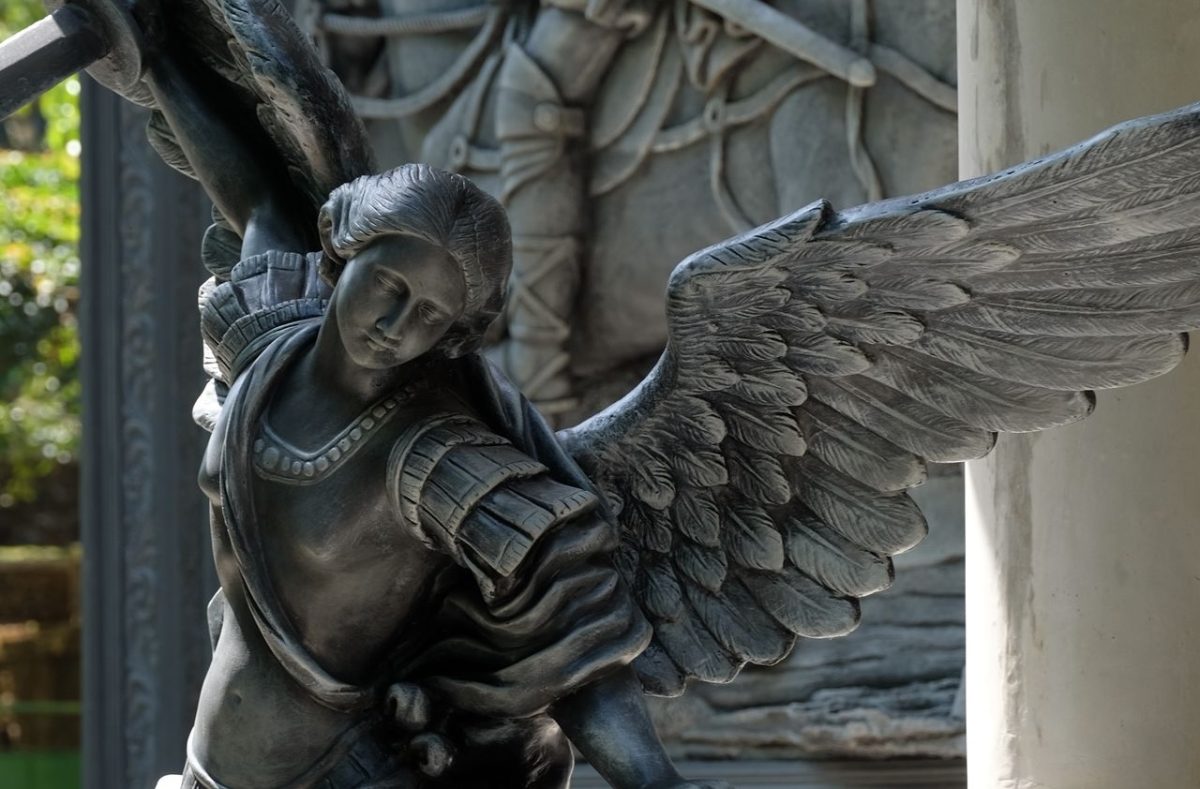
Massachusetts’ highest court just handed the ACLU a weapon to scrub religious history from public life — and it did so by inventing an injury nobody has suffered.
The Supreme Judicial Court blocked Quincy, Massachusetts, from installing two bronze statues of St. Michael the Archangel and St. Florian outside its new public safety building. The city’s crime? The statues are “closely affiliated with a particular religion.”
That’s the entire violation: bronze that might make someone think of Catholicism.
Quincy spent $850,000 building the statues to honor the police officers and firefighters who serve the city. Mayor Thomas Koch chose St. Michael and St. Florian because they capture something ordinary civic plaques cannot — courage that runs toward danger rather than from it, patrons those professions have invoked for centuries.
The court didn’t dispute that. It ruled the statues could still convey “implicit government support” for Catholicism and “subordination of other religions.”
“A test that singles out statues for scrutiny because they are ‘closely affiliated with a particular religion,’ while a mural of secular civic virtues would draw no such review, is not neutral toward religion. It is hostile to it.”
The court’s reasoning has implications well past two statues in Quincy.
Martin Luther King Jr., an ordained Baptist minister and president of the Southern Christian Leadership Conference, preached that America’s civil rights struggle was grounded in the imago Dei. Cities across the country have erected statues of him in the decades since he was taken from us.
Under the court’s reasoning, how long before someone argues that an MLK statue conveys government endorsement of Christianity?
This impulse is not confined to East Coast elites. Secularists on the opposite coast have been pushing the same campaign against California’s own great missionary. Protesters tore down Los Angeles’ statue of Junipero Serra in 2020. Other protesters in San Francisco toppled the Serra statue in Golden Gate Park, and another statue was removed by vote of the Ventura City Council that same summer.
Los Angeles and San Francisco join Saint Paul, Corpus Christi, Sacramento, and a host of other American municipalities that have names with religious pedigrees. The Quincy ruling supplies fresh legal architecture for that same argument, dressed up as constitutional caution rather than blatant religious discrimination.
Quincy tried to make exactly this point to the court. America has never treated the religious identity of a historical or civic figure as disqualifying from public commemoration.
Statues of Junipero Serra, stained glass windows in old courthouses, the National Cathedral hosting state funerals, Ten Commandments friezes on the Supreme Court’s own courtroom walls — all of it exists because the founding generation understood that acknowledging religion’s role in shaping civic virtue is not the same as establishing a church.
The Massachusetts high court brushed past that tradition. It preferred a test that asks whether a statue “might convey” the wrong message to the wrong observer — a test with no limiting principle and no patience for the possibility that a first responder might take comfort in a patron saint watching over the job.
What makes the ruling particularly tone deaf is its timing. Recent surveys show Gen Z, having grown up in the most secular environment American children have ever known, embracing Catholic identity in numbers their parents’ generation did not expect.
Courts applying the establishment clause at the federal level have begun to catch up to that reality and are replacing the reflexive suspicion of the Lemon v. Kurtzman era with a history-and-tradition inquiry that takes the nation’s religious inheritance seriously rather than treating it as a problem to be managed.
For over half a century, courts applying Lemon asked three questions of any law touching religion: Did it have a secular purpose? Did its primary effect advance or inhibit religion? Did it foster excessive government entanglement with religion? The three-part test sounded neutral in theory. In practice, it produced inconsistent rulings and frequently treated even minor public acknowledgments of religion as constitutional threats.
“The ACLU, pointing to a state constitution, hopes to resurrect Lemon under a different name.”
In an amicus brief in support of Quincy, Stanford Law’s Michael McConnell and Emory’s John Witte Jr. warned the court exactly of this outcome. They also explained that nothing in the text of the Massachusetts Declaration of Rights supports grafting onto it a test the U.S. Supreme Court itself has abandoned as unworkable.
Neither the United States Constitution nor the Massachusetts Declaration of Rights requires government to scrub religious references from the public square. Neutrality was never meant to mean sterility.
A city honoring its police officers and firefighters with the patron saints those men and women have invoked for generations is not establishing a religion. It is telling the truth about where a tradition of protection comes from.
If courts cannot tell the difference between commemoration and establishment, the real casualty will not be the ACLU’s preferred vision of a religion-free civic landscape.
It will be every city’s ability to honor its history honestly — saints, ministers, missionaries, and all.