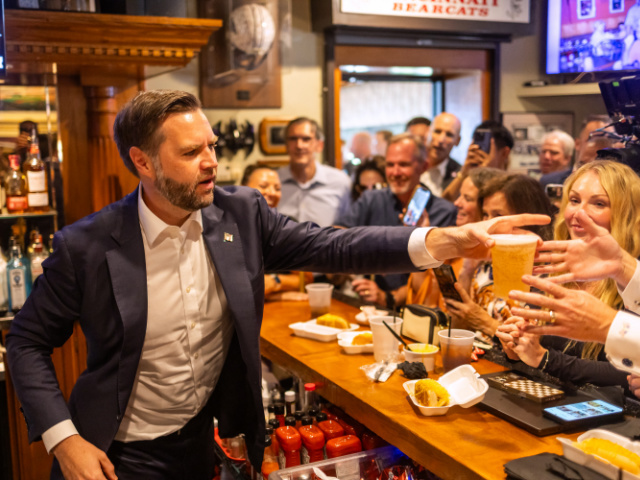
Vice President JD Vance grabbed a tap handle and started pouring beers for locals at a Cincinnati chili restaurant Friday — capping a hometown campaign swing with the kind of Rust Belt moment that drives Democrats crazy.
The scene exemplified the populist, working-class brand that Vance has cultivated since his first Senate campaign. While traditional politicians might keep a careful distance from such informal settings, Vance has made these unscripted moments a signature of his political identity. The optics of a sitting vice president serving beer in his home state carries symbolic weight in a region where cultural authenticity often matters as much as policy positions.
The impromptu bartending session came after Vance delivered a speech at the Cleveland-Cliffs Middletown Works facility — the same steel plant where his grandfather welded for 40 years.
The steel plant represents more than just a campaign backdrop. It stands as a living monument to the industrial economy that once anchored communities like Middletown, and its survival amid decades of deindustrialization makes it particularly resonant for Vance’s messaging about economic nationalism and manufacturing revival. By returning to this specific location, Vance creates a direct through-line from his family’s working-class history to his current policy agenda.
Conservative commentator Eric Daugherty posted video of Vance working the taps, describing him as “rocking the Rust Belt.” One patron shouted from the crowd: “Nice pour, JD!”
BREAKING: VP JD Vance is PERSONALLY serving beers to the locals in Cincinnati, Ohio.
He's rocking the Rust Belt. pic.twitter.com/xyz123
— Eric Daugherty (@EricLDaugh) August 21, 2026
According to the Associated Press, Vance served beers and chili-topped dogs with cheese to the crowd at the local chili spot.
Cincinnati chili restaurants hold particular cultural significance in the region, serving as community gathering places that transcend mere dining. The choice of venue reinforces Vance’s connection to local traditions and working-class social spaces, rather than the country clubs or fundraising galas more typically associated with national political figures.
Earlier in the day, Vance returned to the plant known as Armco Steel when his grandfather James Vance worked there.
“Papaw was a welder in this place for 40 years, and today his grandson stands here as the vice president of these United States. It’s an amazing thing,” Vance said.
The personal narrative Vance draws upon carries particular political potency in regions that have watched manufacturing jobs disappear over recent decades. His grandfather’s four-decade career at a single employer represents a vanished economic reality that many Rust Belt voters remember — stable industrial work that supported families and built communities. Vance’s rise from that background to the vice presidency becomes, in his framing, evidence that such communities still matter in American politics.
The vice president used the speech to slam the modern Democratic Party as unrecognizable to the union-backing party his grandfather supported.
He called today’s Democrats the “party of graduate students” and said his grandfather “hated the people who forgot about this town when they should have been fighting for this town.”
This rhetorical strategy attempts to exploit what Republicans see as a class realignment in American politics, where college-educated professionals have moved toward Democrats while working-class voters — historically a Democratic base — have shifted toward Republicans. By invoking his grandfather’s political allegiance, Vance argues that it’s the party, not these voters, that changed.
Vance conceded voters are feeling the squeeze on prices. He said Trump was working to reverse “40 years of American decline” through immigration and trade policies, including tariffs aimed at protecting jobs like those at the plant.
The acknowledgment of economic pain gives Vance credibility to then pitch his policy solutions. His four-decade timeframe deliberately reaches back to the late 1980s, encompassing both Republican and Democratic administrations in his critique of consensus trade policies that opened American markets to global competition.
Energy Secretary Chris Wright joined Vance for the trip.
Vance has long leaned on his Middletown roots, recounting his upbringing in a viral video released the night before his 2024 vice-presidential debate.
The visit comes as Ohio Republicans defend competitive statewide races. Sen. Jon Husted, appointed to Vance’s old seat, faces former Sen. Sherrod Brown, while Vance ally Vivek Ramaswamy runs for governor against Democrat Amy Acton.
Vance’s high-profile appearance in his home state provides down-ballot Republicans with valuable association at a time when Ohio’s political identity remains contested. Though the state has trended Republican in presidential races, statewide contests remain competitive, making surrogate appearances by popular figures strategically important.
Democrats have increasingly targeted Vance as a likely 2028 contender. Kentucky Gov. Andy Beshear traveled to Middletown in March to attack Vance’s memoir Hillbilly Elegy as “hillbilly hate.”
The Democratic focus on Vance signals they view him as a significant political threat beyond his current role. By challenging his origin story and personal narrative — the foundation of his political appeal — they’re attempting to undermine his authenticity with the working-class voters he courts.
Vance’s office announced a Monday trip to Brewer, Maine, to campaign for former Republican Gov. Paul LePage.