
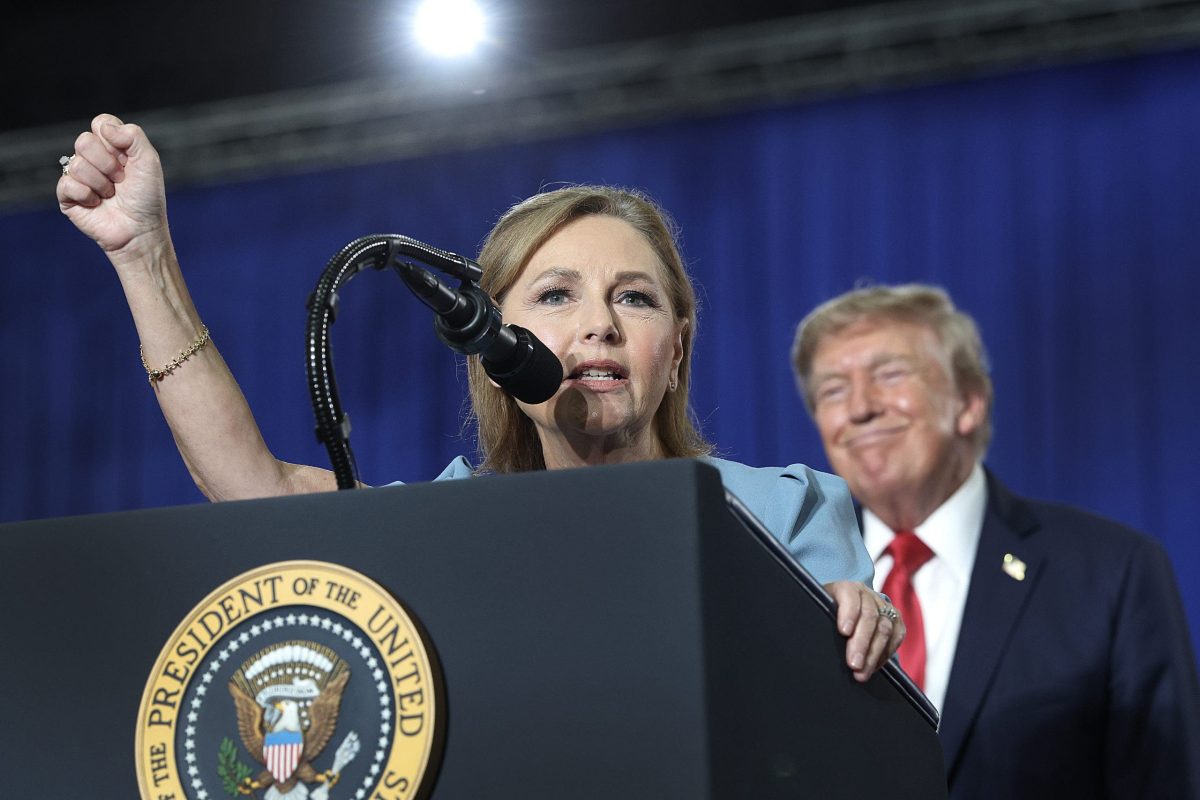
President Donald Trump fired back at a protester who interrupted his South Carolina rally Friday night with a classic Trump quip: your mom’s voting for me anyway.
The protester stood up mid-speech at the Myrtle Beach Convention Center around 7:28 p.m., according to a White House pool report. Convention center staff and police escorted the heckler out as Trump paused briefly to watch the commotion.
The interruption came during a critical portion of Trump’s remarks focused on Republican turnout efforts in the state. Rather than let the disruption derail his momentum or become the story of the evening, Trump seized the moment to connect with his audience through humor—a tactic that has defined his political style since he first descended the Trump Tower escalator in 2015.
Then Trump delivered the punchline.
“That person’s going home to mom. Gonna get scolded because mom is voting for us. You know, mom is voting for us.”
The crowd erupted. Trump immediately moved on with his speech, not giving the interruption another second of oxygen.
The exchange exemplified Trump’s rally instincts: turn opposition into entertainment, defuse tension with a joke, and never let critics control the narrative. It’s a skill he’s honed over hundreds of rallies across nearly a decade of campaigning, and one that consistently energizes his base while frustrating his opponents who hope disruptions will rattle him.
Trump was in Myrtle Beach to rally for Darline Graham, sister of the late Sen. Lindsey Graham, ahead of Tuesday’s GOP Senate runoff. Graham is running to complete her brother’s term after receiving the appointment to finish it out.
The stakes for the runoff extend beyond South Carolina. With the Senate margin razor-thin, every seat matters for Trump’s legislative agenda. A loss here would hand Democrats momentum and potentially complicate confirmations, judicial appointments, and policy priorities for the remainder of Trump’s term. That’s why the president carved time out of his schedule for a rally in a state that typically votes reliably Republican.
The president told supporters to treat the runoff like his own name was on the ballot.
“If Trump isn’t actually on the ballot,” Trump said, before catching himself. “Just come and vote. It’s so important. So, just say that I’m on the ballot one more time. You got to say it, and you got to come out and vote.”
Republican turnout in runoffs is always the challenge — base voters often stay home when Trump’s name isn’t literally printed on the ballot. Trump’s pitch: pretend it is.
The phenomenon isn’t unique to South Carolina. Across the country, GOP strategists have wrestled with the reality that Trump-era Republicans are often motivated by the president himself rather than down-ballot candidates or traditional party loyalty. When Trump isn’t the main attraction, enthusiasm can crater. It’s a dynamic that has complicated special elections and runoffs throughout his time in office, making personal appearances like this one essential rather than optional.
Trump said he personally encouraged Graham to run and laid out why she deserves Washington.
“With your support, Darline will defend common sense in our nation’s capital,” Trump said. “She’ll fight for lower taxes, bigger paychecks, no amnesty for illegal aliens. And she’ll always protect your Second Amendment, the right to keep and bear arms.”
Trump also praised Graham’s commitment to the armed forces.
“But as much as anybody in this Senate and maybe more, Darline will support our military,” Trump said.
The military emphasis makes strategic sense in South Carolina, home to multiple major military installations including Joint Base Charleston, Fort Jackson, and Marine Corps Air Station Beaufort. Military families and veterans represent a significant voting bloc in the state, and one that has traditionally leaned Republican. Trump’s highlighting of Graham’s defense credentials was clearly designed to mobilize that constituency specifically.
Graham joined Trump onstage later in the rally, thanking him for his endorsement and his friendship with her late brother Lindsey.
“Thank you, Mr. President. Thank you for your endorsement. It has meant the world to me. Thank you for your support. Thank you for coming to South Carolina. This is MAGA country, right?”
Her invocation of “MAGA country” signaled her understanding of the political reality: in today’s Republican Party, especially in deep-red South Carolina, alignment with Trump isn’t just helpful—it’s essential. The phrase served as both a pledge of loyalty and a rallying cry designed to activate the exact voters Trump was urging to show up Tuesday.
The South Carolina Senate runoff is Tuesday. Trump’s message to his base: show up like your vote decides whether he wins or loses.