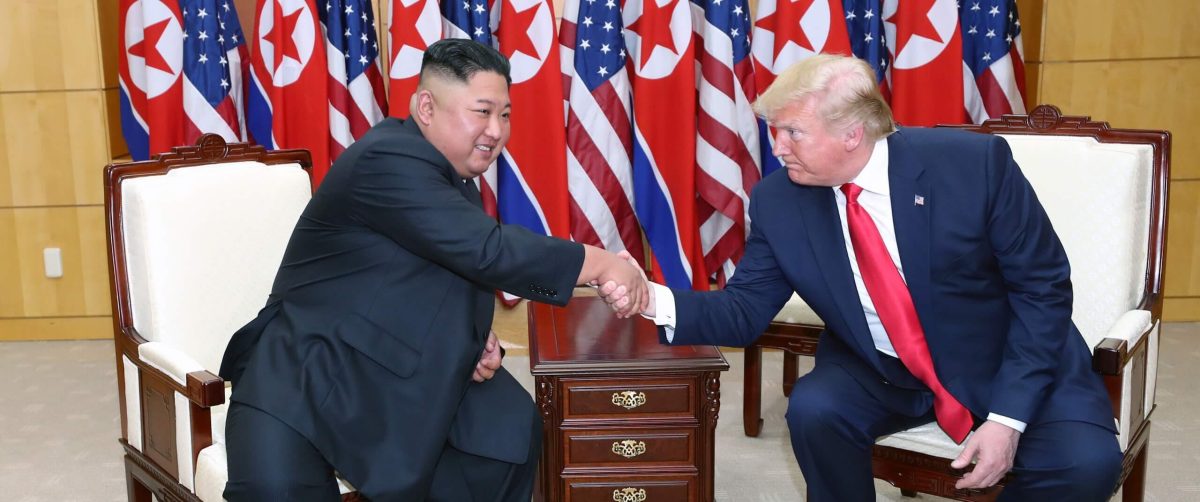
President Trump is pushing to meet with North Korean leader Kim Jong Un this fall — potentially on the sidelines of his November trip to the APEC summit in China.
The move comes after Trump’s August 16 Truth Social post calling for a reduction in joint U.S.-South Korea military exercises and faulting Seoul for declining to support the U.S. effort against Iran. The Wall Street Journal reported August 18 that Trump is now directing aides to arrange the summit as soon as this fall.
Seoul has already responded. South Korea cut this month’s Ulchi Freedom Shield exercise roughly in half after Trump ordered the Pentagon to scale back the drills.
The stakes are high. Biden’s weakness allowed North Korea’s nuclear weapons and missile programs to surge — including a record number of missile launches in 2022. Pyongyang is now arming Russia for the war in Ukraine.
Below are five America First steps to turn Trump’s momentum into a successful summit.
First: Send Secretary of State Marco Rubio to Seoul immediately.
Rubio should finalize the logistics of a Trump-Kim summit this fall — whether standalone or timed to the November APEC trip in China.
Trump has already acted. He ordered the Pentagon to scale back this month’s Ulchi Freedom Shield exercise to just five days — August 17 to 21 — to draw North Korea back to the table. That’s a small price to pay if it gets Kim Jong Un to a summit.
There’s precedent. These exercises were suspended during the George H.W. Bush, Clinton, and first-Trump administrations to avoid interfering with U.S.-North Korea negotiations.
“While President Trump is rightly frustrated by limited allied backing for the Iran campaign, South Korea’s Lee Jae Myung government has delivered stronger-than-anticipated cooperation on trade and security.”
South Korea boosted its 2026 defense budget by 7.5 percent and added $1 billion in support for the 28,500 U.S. troops stationed there. Major shipbuilding agreements are set to expand the U.S. Navy’s capacity.
Unlike several European allies, South Korea didn’t try to undermine the U.S. war effort in Iran by denying access to critical bases or publicly criticizing Trump’s Iran policy.
Second: Name a dedicated North Korea special envoy.
Most previous administrations — including Trump’s first term — have named a special envoy to work full-time on peace talks and denuclearization. The recommendation: Assistant Secretary of State for East Asian and Pacific Affairs Michael George DeSombre, a Senate-confirmed official with deep Asia-Pacific experience and a clear America First orientation.
Third: Coordinate closely with Japan and regional partners.
The U.S.-South Korea-Japan Trilateral partnership is crucial to any successful Trump-Kim engagement. The U.S. should also consult with Australia, India, the Philippines, Taiwan, and the United Kingdom.
Fourth: Direct Commerce Secretary Scott Bessent and Energy Secretary Chris Wright to clear remaining obstacles to U.S.-South Korea trade and energy agreements.
Important understandings on trade and nuclear energy reached by Presidents Trump and Lee last September have faced delays on both sides. U.S. bureaucratic inertia — particularly inside the Department of Energy — and congressional hesitation have contributed to the delays.
After an Oval Office meeting, both secretaries should travel to Seoul for high-level talks. Bessent should also examine reports of difficulties faced by American companies operating in South Korea and identify rapid solutions.
Fifth: Have President Trump meet with President Lee — ideally by visiting Seoul.
A presidential trip to South Korea would powerfully convey Trump’s commitment to the U.S.-South Korea relationship and his determination to resume personal diplomacy with Kim Jong Un. Trump could reinforce his message by delivering another major address to the South Korean National Assembly, as he did in 2018.
These steps build on the existing strong U.S.-South Korea partnership, advance American interests, and create space to resolve lingering bilateral frictions. Most importantly, they provide the foundation for a vigorous second-term strategy that builds on the personal diplomacy President Trump successfully initiated with Kim Jong Un during his first term.