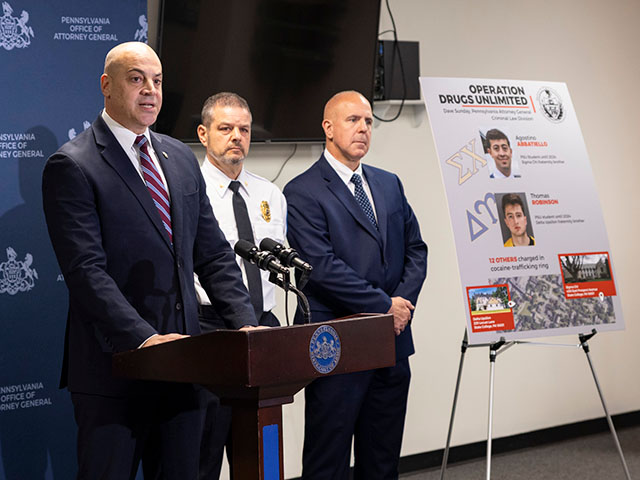
Fourteen individuals face charges after authorities busted a cocaine-trafficking ring operating out of two Penn State fraternities — Delta Upsilon and Sigma Chi. The arrests mark the culmination of a lengthy investigation into drug distribution networks that had embedded themselves within the university’s Greek life system, raising serious questions about oversight and safety at one of the nation’s largest public universities.
The case represents a troubling intersection of campus culture and serious criminal enterprise. Fraternities have long faced scrutiny over hazing, alcohol abuse, and party culture, but this investigation reveals something far more serious: the alleged use of fraternity infrastructure to facilitate organized drug trafficking. The Greek system at Penn State, like at many major universities, operates with a degree of autonomy that can sometimes create blind spots for university administrators and law enforcement alike.
Pennsylvania Attorney General Dave Sunday called it what it was.
“This is very serious criminal conduct. There was nothing junior or child-like about this conduct — this was an upper-level trafficking organization for this region of Pennsylvania.”
Sunday’s characterization underscores the scale and sophistication of the alleged operation, which authorities say functioned not as casual drug use among students, but as a coordinated distribution network serving the broader State College region. The distinction is critical: this was not simply students experimenting with drugs, but rather students allegedly running a business that supplied a significant portion of central Pennsylvania.
Thirteen of the accused were Penn State students at the time of the alleged trafficking, which ran from 2023 to 2024. The fourteenth suspect: a student’s father, who allegedly tried to hide evidence and obstruct the investigation. The involvement of a parent adds another disturbing layer to the case, suggesting that at least one family member may have been aware of the illegal activity and actively worked to conceal it from authorities rather than intervening to stop it.
Agostino Abbatiello and Thomas Robinson allegedly served as the suppliers, making runs to Philadelphia and New York to pick up large batches of cocaine. Authorities say the drugs were cut and packaged primarily at the fraternity houses before being distributed — mostly to Penn State students. The use of fraternity facilities for these purposes raises immediate concerns about what other members and house leadership may have known, and whether the national organizations that charter these chapters had any indication of the alleged criminal activity occurring under their names.
Four defendants — Abbatiello, Robinson, Mohammed Hurabi, and Lars Zeepvat — face felony charges including corrupt organizations, conspiracy, and dealing in proceeds of unlawful activity. The corrupt organizations charge is particularly significant, as it is typically reserved for cases involving organized criminal enterprises and carries substantial prison time upon conviction.
A fifth person, Robert Zanolla, faces felony conspiracy and criminal use of a communication facility charges. The communication facility charge indicates that investigators likely have evidence of the alleged traffickers using phones, computers, or other devices to coordinate their activities.
The remaining eight student-aged defendants are facing misdemeanor counts of possession and paraphernalia. While these charges are less severe, they still carry serious consequences that could impact these individuals’ academic standing, career prospects, and future opportunities.
Police used wiretaps, surveillance, and payment-app tracking to map the operation. Officials noted that most payments were made in cash or via payment apps. The use of modern investigative techniques, including digital surveillance of financial transactions through popular payment platforms, reflects how law enforcement has adapted to track criminal activity that increasingly relies on technology. The wiretap authorization alone signals that investigators presented compelling evidence to a judge that serious crimes were being committed.
Cocaine is an addictive stimulant that increases risk of heart attack, stroke, and overdose. The Cleveland Clinic warns it can cause paranoia, loss of inhibitions, and brain changes that lead to addiction. The health risks associated with cocaine use are compounded when drugs are cut with unknown substances, a common practice in street-level distribution that can introduce additional dangers including deadly contaminants like fentanyl.
The case is a stark reminder: these weren’t kids making bad choices. This was an organized trafficking operation running drugs into a major university. The distinction matters not only for how we understand the criminal conduct, but also for how universities, parents, and communities need to approach the serious problem of drug trafficking that can take root in campus environments when sophisticated criminal operations exploit the freedoms and social structures of college life.
13 Penn State frat bros busted in cocaine trafficking ring-including LI student at 'top of the food chain' https://t.co/NHYGRE1SHw pic.twitter.com/beiQCMOClg
— New York Post (@nypost) August 18, 2026
Attorney General Dave Sunday will announce the results of a long-term investigation of drug-trafficking in the State College area.
Attorney General Sunday will detail the investigation, individuals charged, and the criminal conduct’s impact on the community.…
— PA Attorney General Dave Sunday (@PAAttorneyGen) August 17, 2026