Michigan Democrats are already looking past Kamala Harris.
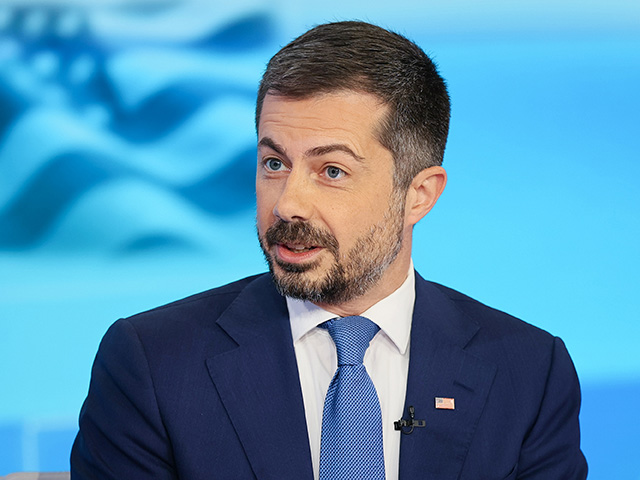
A new poll shows 24 percent of likely Democrat voters in Michigan backing former Transportation Secretary Pete Buttigieg for president in 2028 — while Harris, the party’s 2024 nominee who lost to President Trump, draws just 5.1 percent.
The findings suggest a broader shift in the Democratic Party’s outlook following the 2024 defeat, with voters in the critical swing state reassessing their options early in the next presidential cycle. Michigan has long been viewed as a bellwether for Democratic strategy, making these numbers particularly significant for party strategists attempting to chart a path forward after losing the White House.
The Public Sentiment Institute survey asked Michigan Democrats: “If the 2028 Democrat Primary was held today, who would you vote for?”
Buttigieg led the field. Georgia Sen. Jon Ossoff came in third. Harris finished a distant fourth.
The former Transportation Secretary’s first-place showing represents a remarkable political comeback after his own 2020 presidential campaign fell short. Buttigieg has maintained visibility since serving in the Biden administration, though his current standing remains undefined as the Democratic Party enters what many observers describe as a period of profound soul-searching about its direction and priorities.
But the real story? 21.7 percent said they were undecided — the second-highest response.
“Undecided finishes second. More than a fifth of this electorate has no 2028 preference at all.”
The poll’s authors noted that pushing undecided voters onto a candidate list “would be a fabrication dressed up as precision.”
Translation: Michigan Democrats have no idea who they want — but they know it’s not Kamala.
This level of uncertainty so early in the cycle reflects the unsettled state of Democratic politics in the aftermath of electoral defeat. While early polling often shows high undecided numbers, the specific rejection of the party’s most recent standard-bearer is noteworthy and suggests Harris faces significant headwinds should she pursue another campaign. The 2028 race remains years away, but these early indicators help shape fundraising, endorsements, and strategic positioning among potential candidates.
On the Republican side, President Trump commented in June on a possible 2028 ticket of Vice President JD Vance and Secretary of State Marco Rubio.
“I watch them together. They get along great. They have a good relationship. They’re sort of similar in a lot of ways, but they’re very talented. I think the two of them running together as a team would be very unbeatable,” Trump said.
The contrast between Republican unity and Democratic uncertainty could not be more stark. While the GOP appears to have a clear succession plan in place, Democrats are navigating a crowded and fragmented field with no obvious frontrunner commanding significant support.
Harris has reportedly been privately contacting progressive Democrats, pro-Palestinian activists, and former aides ahead of a possible 2028 run — despite the Michigan numbers showing Democrat voters have already moved on.
These outreach efforts suggest Harris remains undeterred by early polling, though her focus on specific constituencies rather than broad coalition-building may indicate a narrower path forward than her 2024 campaign attempted. The gap between her behind-the-scenes maneuvering and her public support numbers raises questions about whether she can rebuild the credibility necessary for a competitive primary campaign.
The same poll questioned voters on Israel — and the results show how far left Michigan Democrats have shifted.
When asked if they’d be more or less likely to support a Senate candidate who accepted campaign contributions from a pro-Israel PAC, 55.8 percent said less likely. Just 7.5 percent said more likely.
“Among Michigan Democratic primary voters, accepting pro-Israel PAC money is a net liability by roughly seven to one,” the poll noted.
The “much less likely” response alone outweighed the entire favorable side five times over.
These attitudes represent a dramatic realignment within the Democratic base, particularly in Michigan with its substantial Arab American population. The political calculus around Middle East policy has fundamentally changed for Democrats seeking statewide or national office, creating potential tensions between traditional party donors and an increasingly skeptical grassroots electorate.
Sen. John Fetterman warned in July that Democrats would continue backing away from Israel and refusing to defend the Jewish community in America.
“It won’t stop. In fact, if anything, it’s going to accelerate. Look at the people that have won. They’ve — anti-Israel, anti-American, anti-Western Civilization overall,” Fetterman said.
His warning underscores the intraparty divide that any 2028 candidate will need to navigate, balancing competing constituencies with fundamentally different worldviews on foreign policy and America’s role in international affairs.
The 2028 Democrat field is wide open — and Kamala Harris is already losing it.
2028 MICHIGAN DEM PRIMARY
🔵 Buttigieg: 24%
🔵 Ossoff: 14%
🔵 AOC: 11%
🔵 Newsom: 10%
🔵 Harris: 5%
🔵 Shapiro: 4%
🔵 Pritzker: 4%
🔵 Hunter Biden: 2%
🔵 Booker: 1%
🔵 Khanna: 1%
🔵 Emanuel: 1%
🔵 S.A. Smith: 1%
🔵 Moore: 1%
⚪️ Not sure: 22%@TPSIOfficial | 7/25-29 | 762 LV… pic.twitter.com/GpPxEHMhk2— InteractivePolls (@IAPolls2022) August 1, 2026