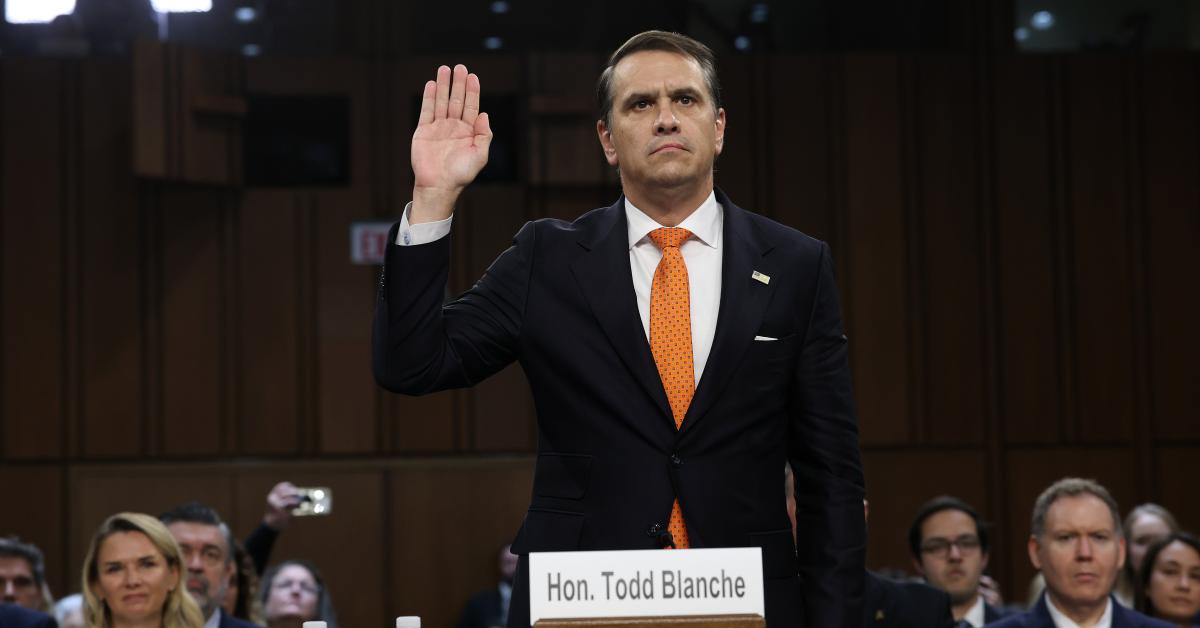
President Trump warned Saturday he will keep Todd Blanche as acting attorney general and push for an “anti-weaponization bill” if two Republican senators continue blocking his nominee for the nation’s top law enforcement post.
The threat targets Sens. John Cornyn (R-TX) and Thom Tillis (R-NC) — the only GOP holdouts on the Blanche nomination. Their opposition represents a rare intraparty challenge to a president who has largely commanded unified Republican support for his Cabinet and key personnel selections during this term.
Both senators lost their recent political fights. Cornyn lost his reelection bid. Tillis quit. The political setbacks have created what Trump views as personal grievances affecting their willingness to support his nominees, a dynamic that has now escalated into a public confrontation over one of the administration’s most critical appointments.
“IF SENATORS CORNYN AND TILLIS, BOTH UPSET BECAUSE I WOULDN’T ENDORSE THEM (THEY LOST, AND QUIT, RESPECTIVELY!), AREN’T GOING TO APPROVE TODD BLANCHE, ONE OF THE MOST RESPECTED PROFESSIONALS, ACCORDING TO EVERYBODY, IN THE COUNTRY, TO BE THE UNITED STATES ATTORNEY GENERAL, THEN I WILL KEEP TODD AS ACTING A.G., AND PUSH HARD TO GET THE ANTI-WEAPONIZATION BILL, WHICH TAKES CARE OF THOSE WHO HAVE BEEN SO BADLY TREATED BY THE CROOKED JOE BIDEN (AND OBUMA!) ADMINISTRATION (I GET NOTHING, ALTHOUGH I WAS TREATED HORRIBLY!), PASSED.”
Trump’s Truth Social post marks a sharp pivot from his earlier strategy — a $1.8 billion fund he was pursuing before the Senate roadblock emerged. That initial proposal had been quietly circulating among Republican leadership as a way to address what the president characterizes as politically motivated prosecutions undertaken during previous Democratic administrations.
The anti-weaponization bill would compensate Americans targeted by what Trump calls the “Crooked Joe Biden” and Obama administrations’ politicized prosecutions. The legislative proposal reflects Trump’s long-standing criticism that the Department of Justice has been used as a political weapon against conservatives and his allies, a complaint that has become central to his political messaging since leaving office in 2021 and returning to the White House.
Trump made clear he personally would receive nothing from the fund, despite what he describes as being “treated horribly.” This preemptive clarification appears designed to deflect potential criticism that the legislation would be self-serving, given Trump’s own experience with multiple investigations and prosecutions during and after his previous term in office.
The president praised Blanche as “a voice of reason” and vowed the anti-weaponization proposal “will immediately be back on the table.” Blanche, who previously served as one of Trump’s defense attorneys during his legal battles, has emerged as a trusted figure within the president’s inner circle and was selected for the attorney general position based on that personal loyalty and legal expertise.
“Todd Blanche was a voice of reason! It will immediately be back on the table, and I will get it done,” Trump added in the post.
The standoff puts Senate Republicans in a bind — confirm Blanche or face Trump pushing compensation legislation for DOJ targets that could dwarf the original $1.8 billion proposal. The ultimatum represents a high-stakes gambit that could force Republican senators to choose between maintaining institutional prerogatives over confirmation processes and avoiding a potentially more costly legislative battle that would dominate the political agenda and create divisions within the party.
Cornyn and Tillis have not publicly explained their opposition to Blanche, who Trump says is universally respected in legal circles. The silence from both senators has fueled speculation about their motivations, with Trump attributing their stance to resentment over his decision not to endorse them in their respective political campaigns. Without public statements outlining specific concerns about Blanche’s qualifications or judicial philosophy, the dispute appears increasingly personal rather than substantive.
The Senate Judiciary Committee has rescheduled its vote on the Blanche nomination, signaling continued uncertainty over whether he can clear the panel. The delay suggests ongoing negotiations behind the scenes as Senate leadership attempts to broker a resolution that would avoid a protracted confirmation battle while maintaining party unity on a critical national security position.
If Blanche remains blocked, Trump’s acting AG strategy would allow him to keep his preferred pick in place while simultaneously weaponizing the confirmation fight into a broader push for anti-weaponization legislation — turning the senators’ obstruction into a rallying cry for reform. This dual-track approach would enable the president to maintain operational control over the Justice Department through an acting appointee while simultaneously advancing a legislative agenda that resonates with his political base and puts pressure on Republican senators to either relent on the nomination or explain their opposition to compensating what Trump characterizes as victims of political persecution.