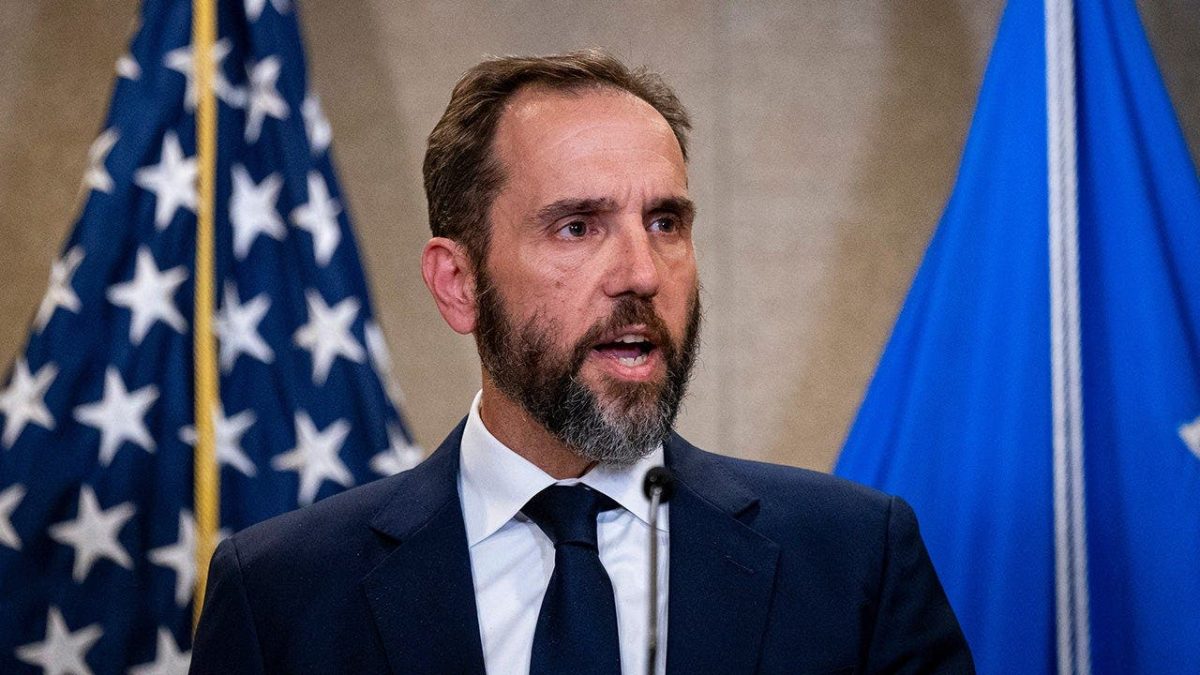
Jack Smith’s investigative team obtained and reviewed text messages exchanged between Trump White House officials and 44 current and former members of Congress, according to Justice Department records released by two Republican-led Senate committees.
The messages were contained in White House records subpoenaed from the National Archives covering Oct. 1, 2020, through Jan. 20, 2021.
The Justice Department admitted Smith’s team “apparently bypassed” a filter team established to screen potentially privileged material before investigators accessed it.
House Judiciary Committee Chairman Jim Jordan, R-Ohio, on Wednesday issued a criminal referral for Smith, arguing he misled Congress when he stated he did not obtain or review lawmakers’ text messages while carrying out his probes into President Donald Trump.
“JACK SMITH’S CRIMINAL INVESTIGATION OF PRESIDENT TRUMP WAS A RUNAWAY TRAIN THAT HAD NO BRAKES.”
The referral functions as an invitation for the Justice Department to launch an investigation into Smith’s conduct.
Read the list of 44 lawmakers:
Among the senators targeted in the probe were: Sens. Chuck Grassley, R-Iowa; Ron Johnson, R-Wis.; John Cornyn, R-Texas; Lindsey Graham, R-S.C.; Josh Hawley, R-Mo.; Mike Lee, R-Utah; Cory Booker, D-N.J.; Cindy Hyde-Smith, R-Miss.; Dan Sullivan, R-Alaska; David Perdue, R-Ga.; Lamar Alexander, R-Tenn.; Martha McSally, R-Ariz.; Rand Paul, R-Ky.; Rick Scott, R-Fla.; Rob Portman, R-Ohio; Roy Blunt, R-Mo.; Susan Collins, R-Maine; Tim Scott, R-S.C.; Tom Cotton, R-Ark.; and Cory Gardner, R-Colo.
On the House side, the investigation targeted: Reps. Kevin McCarthy, R-Calif.; Steve Scalise, R-La.; Jim Jordan, R-Ohio; Devin Nunes, R-Calif.; Adam Smith, D-Wash.; Andy Biggs, R-Ariz.; Mark Walker, R-N.C.; Bryan Steil, R-Wis.; Dan Newhouse, R-Wash.; Doug Collins, R-Ga.; Dusty Johnson, R-S.D.; Elise Stefanik, R-N.Y.; John Katko, R-N.Y.; Josh Gottheimer, D-N.J.; Karen Bass, D-Calif.; Ken Buck, R-Colo.; Lee Zeldin, R-N.Y.; Mario Diaz-Balart, R-Fla.; Mo Brooks, R-Ala.; Morgan Griffith, R-Va.; Rodney Davis, R-Ill.; Russ Fulcher, R-Idaho; Scott Perry, R-Pa.; and Thomas Massie, R-Ky.
Grassley and Johnson, through their senior committee positions, were responsible for the release of the new documents.
Several lawmakers on the list had publicly documented roles in efforts surrounding the 2020 election, including those who have since condemned Smith’s review of their communications.
Sen. Chuck Grassley
As president pro tempore of the Senate, Grassley played a procedural role on Jan. 6, 2021, as Congress moved to certify the results of the 2020 presidential election. Prior to Jan. 6, Grassley suggested he may preside over the Senate’s debate on disputes over the 2020 election if Vice President Mike Pence didn’t show up.
“Based on the information that’s been produced to me and Senator Johnson, Biden DOJ and FBI investigators apparently ignored their own routine investigative protocols to obtain and review work-related messages from me and dozens of my Republican and Democrat colleagues who were outside the scope of the government’s investigation,” Grassley said.
Sen. Ron Johnson
In the lead-up to Jan. 6, Johnson joined a group of Republican senators calling for an emergency 10-day audit of disputed election results and saying they would vote against certifying electors from contested states unless such a review occurred.
“THIS IS YET ANOTHER GROTESQUE EXAMPLE OF THE BIDEN ADMINISTRATION’S WEAPONIZATION OF THE JUSTICE DEPARTMENT.”
“Jack Smith’s team acted with impunity as they disregarded their own protocols to obtain and access White House text messages, including messages to and from 44 Members of Congress,” Johnson said.
Sen. Lindsey Graham
In the days after the 2020 election, Graham urged Trump not to concede. He later donated to Trump’s legal defense fund and, as chairman of the Senate Judiciary Committee, opened inquiries into election procedures in several battleground states and contacted state election officials.
Graham fully broke with the movement after the riot on Jan. 6. “Count me out,” he said at the time. “Enough is enough.”
Sen. Josh Hawley
Hawley is notable in that he, on Dec. 30, 2020, became the first senator to announce his intention to formally object to Electoral College votes during the certification process. His decision was consequential as federal law required objections from both a representative and a senator to force a debate on the election.
Trump attempted to call Hawley six times ahead of the Jan. 6 breach, according to White House call logs obtained by the House Jan. 6 select committee, showing that there was a line of communication between the two.
Hawley called the documents released by Grassley and Johnson “more evidence of Biden corruption. Jack Smith illegally scooped up the text messages of Senators — including mine.”
Sen. Mike Lee
Text messages turned over by former White House chief of staff Mark Meadows to the House Jan. 6 committee show that Lee discussed possible legal and constitutional avenues for challenging the 2020 election results. Lee initially told Meadows he supported exhausting every available legal and constitutional remedy to address concerns about the election.
By Jan. 3, 2021, however, he warned that the effort “could all backfire badly,” according to text messages Meadows turned over to the House Jan. 6 committee. The senator ultimately voted against sustaining objections to Arizona’s and Pennsylvania’s election results.
Mike Lee slammed Smith’s collection of text messages this month as “un-American” and argued that it came “uncomfortably close to spying on a coequal, coordinate branch.”
Rep. Steve Scalise
Scalise, as House Republican whip, was responsible for convincing representatives to vote in line with the party’s interests, providing a straightforward reason as to why White House staff may have been in contact with him. The Louisiana congressman called congressional action the “only remaining recourse” for addressing what he described as improper changes to election laws in several states.
While he condemned rioting, Scalise, like Hawley, ultimately voted to reject Biden’s electoral votes from both Arizona and Pennsylvania.
Rep. Jim Jordan
Jordan participated in efforts to challenge the 2020 election results, including discussions about delaying congressional certification and objecting to electoral votes. On Jan. 2, the Ohio congressman led a conference call with Trump and other members of Congress to discuss strategies for delaying the Jan. 6 joint session, according to the House Jan. 6 committee’s final report.
Jordan also reportedly had a 10-minute call with Trump on the morning of Jan. 6, according to publicly released phone records. After the breach of the Capitol, Jordan condemned the violence but voted to sustain objections to the electoral results in Arizona and Pennsylvania.
“You can’t do that. As Senator Hawley just said, this is a separation of powers issue,” Jordan told Fox News host Sean Hannity earlier this month. “There’s a speech or debate clause. It was supposed to be filtered and screened. It wasn’t. It was just given from the National Archives to Jack Smith’s team.”
Smith’s attorneys called the criminal referral “meritless” Thursday in a letter obtained by Fox News Digital.
“The House Judiciary Committee’s referral to the Department of Justice of our client Jack Smith is based on a spurious claim that Mr. Smith provided false testimony during his eight-hour deposition on December 17, 2025. The referral is made not because Mr. Smith made a false statement — the letter concedes he did not — but because he did not proactively disclose information that was not responsive to a question asked,” the lawyer wrote.
“This referral reflects a chilling eagerness to weaponize the justice system by attacking a career, nonpartisan public servant who faithfully and fearlessly performed his duties by following the facts and the law.”