
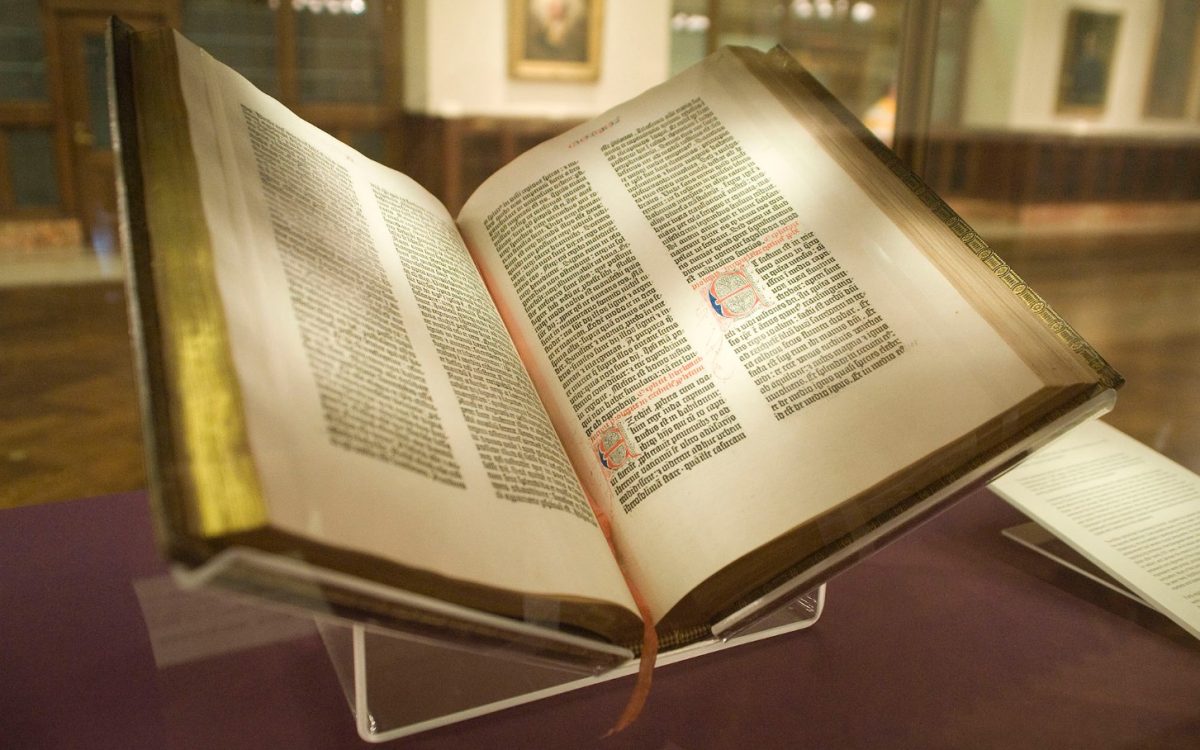
The Texas State Board of Education last week approved a mandatory K-12 reading list that includes portions of the Bible alongside classical literature — and the secular left immediately exposed exactly why biblical literacy matters.
Democrat board member Tiffany Clark complained that “Bible lessons should be taught on Sundays. Not all of us believe the same.”
Yet Clark never protested when Texas public schools hosted drag queen story hours. Apparently twerking performers qualify as high art while the most influential book in Western civilization gets banned.
Clark’s charge that the board is forcing religious instruction misses the entire point. The Bible appears on the reading list as a critical piece of classical literature — which it objectively is — not as Sunday School material.
“A mandatory public school reading list should never function as a bible lesson. Texas is telling public school students that the Bible is the most important book they will read in their English classes.”
That complaint came from Annie Laurie Gaylor, Co-President of the Freedom from Religion Foundation. She’s accidentally correct.
The Bible is the most important book students will encounter in English class — even if one rejects its theology entirely — because millions who shaped Western civilization and the United States did not reject it.
The approved curriculum already includes Greek and Roman mythology, Aesop’s Fables with Greek religious undertones, the pagan-filled Beowulf, and the Old Testament claimed by both Christians and Jews. Critics don’t object to those. They object to the one religious text that still holds cultural power in Texas — where churches dot the landscape as frequently as oil rigs.
If Texas students are to understand why those churches exist and the nature of their influence on American culture, it starts with reading the book that inspired them.
The hysterical response isn’t just anti-God. It’s anti-intellectual.
Augustine, Chaucer, Shakespeare, Milton, Dickens, Dostoevsky, Tolstoy, and Flannery O’Connor are virtually unintelligible without working knowledge of the Bible. Try understanding A Christmas Carol — also on the Texas reading list — or merely the title of Faulkner’s Absalom, Absalom! without that foundation.
The principle extends to Christianity’s fiercest critics. Hume, Marx, Nietzsche, and Sartre were products of Christian culture. The Bible gave them their moral vocabulary and the framework they reacted against.
Indian scholar Vishal Mangalwadi, author of The Book that Made Your World: How the Bible Created the Soul of Western Civilization, explained that the Declaration of Independence’s central premise — “all men are created equal” with “unalienable Rights” — is incoherent nonsense outside the Christian West.
Indian society, he noted, is built on the opposite idea. Physical, material, intellectual, and social inequalities are obvious. The Declaration only makes sense if you share Christian assumptions that human equality is spiritual and rights flow from a Creator.
As a graduate student teaching Western civilization, the author required students to read Genesis chapters 1-2, the Ten Commandments from Exodus 20, the Sermon on the Mount from Matthew 5-7, and the trial-crucifixion-resurrection account in John 19-21.
One exceptionally intelligent Chinese student entered class stunned: “Did you read this? It says this guy came back from the dead!”
That moment revealed the scale of biblical illiteracy. Without some knowledge of the Bible, students have no hope of understanding the fall of Rome, the Reformation, the rise of capitalism and science, the abolitionists, the civil rights movement, or American exceptionalism.
When the faculty at an elite preparatory school challenged the Bible’s inclusion, the headmaster — an agnostic but classically educated liberal — accepted the argument as both true and valid.
“Carry on, Mr. Taunton.”
The great irony: Clark, Gaylor, and other critics employ arguments for exclusion that appeal to fairness, equality, and tolerance — standards that only find meaning in a Christian context. They’ve absorbed just enough Christian ethos to make broken use of its logic.
Niall Ferguson, Senior Fellow at Stanford’s Hoover Institute, quotes an unnamed Chinese scholar in his book Civilization: The West and the Rest: “The heart of your culture is your religion: Christianity. That is why the West has been so dynamic. Christianity is the reason for your success.”
Ferguson argues the decline of the West traces in part to the decline of robust Christian presence in Western culture.
At a debate in the Oxford Museum of Natural History, atheist biologist Richard Dawkins asserted Christianity played no role in the rise of science. Philosopher John Lennox replied that the very building hosting their debate was built with funds from the Bible Society.
Dawkins scoffed. He was wrong.
Oxford professor Sir Henry Acland, a devout Christian, initiated construction with Bible-sale funds. Acland wanted students to “unravel the complex mechanisms and prescient intentions of the Maker of all.”
Dawkins, like Clark and Gaylor, blinded by hatred of a book he doesn’t understand, failed to recognize it made the science he studied — indeed, the very outlines of his own intellectual processes — possible.
As Kepler remarked, “Science is the process of thinking God’s thoughts after him.”
The Bible is the prequel to everything.