
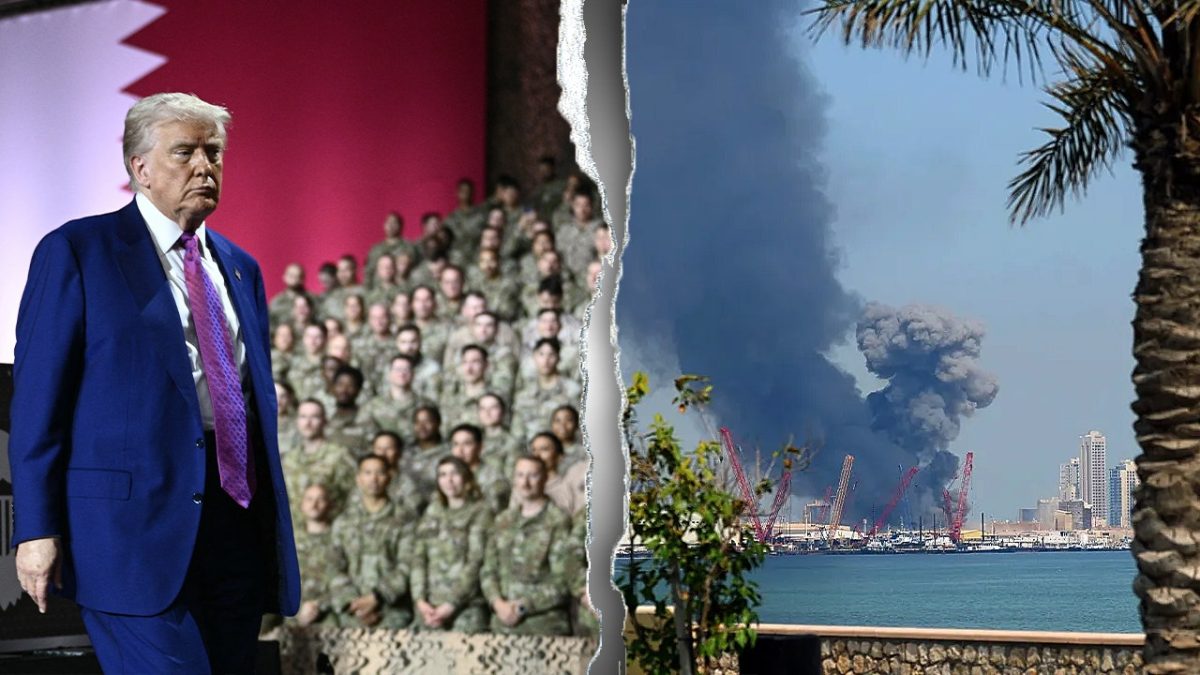
Iran’s relentless missile and drone attacks during Operation Epic Fury exposed a dangerous reality: America’s largest military bases in the Gulf sit within easy striking range of Iranian weapons — and the Pentagon is now scrambling to figure out what to do about it.
For decades, the U.S. military bet big on clustering aircraft, ships, and thousands of troops at a handful of massive Gulf installations like Al Udeid Air Base in Qatar and Naval Support Activity Bahrain. The logic was simple: the closer U.S. forces were to potential hotspots, the faster they could respond.
But Iran just proved that calculus is broken.
“We’re not relying on them in the same way that we did before the war. I think we are going to reposition these forces.”
Retired Navy Rear Adm. Mark Montgomery told Fox News Digital the military has already started leaning more heavily on alternate command-and-control locations and rotating forces rather than concentrating everything at fixed sites near Iran.
During Operation Epic Fury, Iran launched repeated strikes against some of the Pentagon’s most critical regional hubs — including Naval Support Activity Bahrain, home to the U.S. Fifth Fleet, Al Udeid in Qatar, Al Dhafra in the UAE, and Ali Al Salem in Kuwait.
U.S. and partner air defenses shot down many of the incoming weapons, and casualties stayed limited. But the attacks proved virtually every major American base in the Gulf now sits within range of Iranian missiles and drones.
Naval Support Activity Bahrain alone took extensive damage to command facilities and communications infrastructure, the Wall Street Journal reported. Since the conflict began Feb. 28, 13 U.S. service members have been killed and 400 wounded, with most wounded returning to duty.
Navy Capt. Tim Hawkins, Central Command spokesperson, told Fox News Digital the U.S. military “rightfully prioritized the protection of people over buildings, and our strategy of protecting people worked.”
“Iran shot more than 8,000 missiles and drones and only two resulted in U.S. fatalities. We did far more damage to Iran than they did to us — by a lot.”
Now defense officials are weighing whether to scatter military capabilities across a broader network of facilities, move some bases farther west, and even relocate certain operations to Israel, while shrinking the U.S. presence at some installations in Kuwait and Saudi Arabia, according to the Journal.
Officials are also reportedly considering moving some command structures underground or skipping rebuilding damaged structures entirely.
A senior U.S. official told Fox News Digital the debate over dispersing forces and reducing reliance on a few large Gulf bases predated Operation Epic Fury — but the conflict reignited those conversations with new urgency.
Retired Adm. Kevin Donegan, former commander of the U.S. Navy’s Fifth Fleet, told Fox News Digital the issue is absolutely being discussed.
“After (the Iran conflict) is over, I think in each country it’ll be independently evaluated based on our relationships with those countries,” Donegan said.
Montgomery pointed to geography as a core problem. Many of the Gulf’s largest U.S. bases sit only about 90 miles from Iranian launch sites — leaving little time and space to intercept incoming drones after launch.
“They’re just too close,” Montgomery said. “They’re…90 miles away from Iranian launch points.”
Fighter aircraft have become a primary tool for shooting down Iranian drones, but Montgomery said the Gulf’s proximity to Iran leaves defenders with less time and room to maneuver.
“Our way of shooting down drones, the best way is aircraft equipped with rockets,” he said. “But to do that, you got to get behind the drones. That’s hard.”
Moving operations farther west wouldn’t put U.S. troops beyond the reach of all Iranian weapons — Iran’s longer-range missiles can hit Israel and other parts of the region. But dispersing command nodes, aircraft, logistics hubs, and personnel across more locations could reduce the risk of a single strike crippling a critical U.S. capability.
Donegan cautioned there may no longer be any truly safe rear area.
“Everywhere we have forces around the world, they are under the missile envelope of potential adversaries,” he said. “So, where do you go to?”
But he also noted the U.S. presence in the Gulf isn’t just about Iran.
“What you can do is buy yourself a little time against the threat, but in the end, we still need to have access to basing, because our being in the Gulf is not just to revolve around Iran, we have other reasons to be there, whether that be to ensure that terrorists like ISIS and Al Qaeda, etc. don’t threaten stability,” Donegan said.
The U.S. typically maintains about 40,000 troops across the Middle East, anchored by a network of major bases built up during the post-9/11 wars. Al Udeid Air Base in Qatar — home to the forward headquarters of U.S. Central Command and the largest U.S. military installation in the region — alone hosts about 10,000 American personnel.
Those installations became the backbone of U.S. military operations during the wars in Afghanistan and Iraq and remain central to American air, naval, and logistics operations across the region.
A War Department official told Fox News Digital the Pentagon has no force posture changes to announce at this time. A Joint Staff spokesperson said the military is tracking diplomatic developments while continually monitoring and evaluating U.S. force posture.
The charges remain allegations. The case has not been proven in court.