
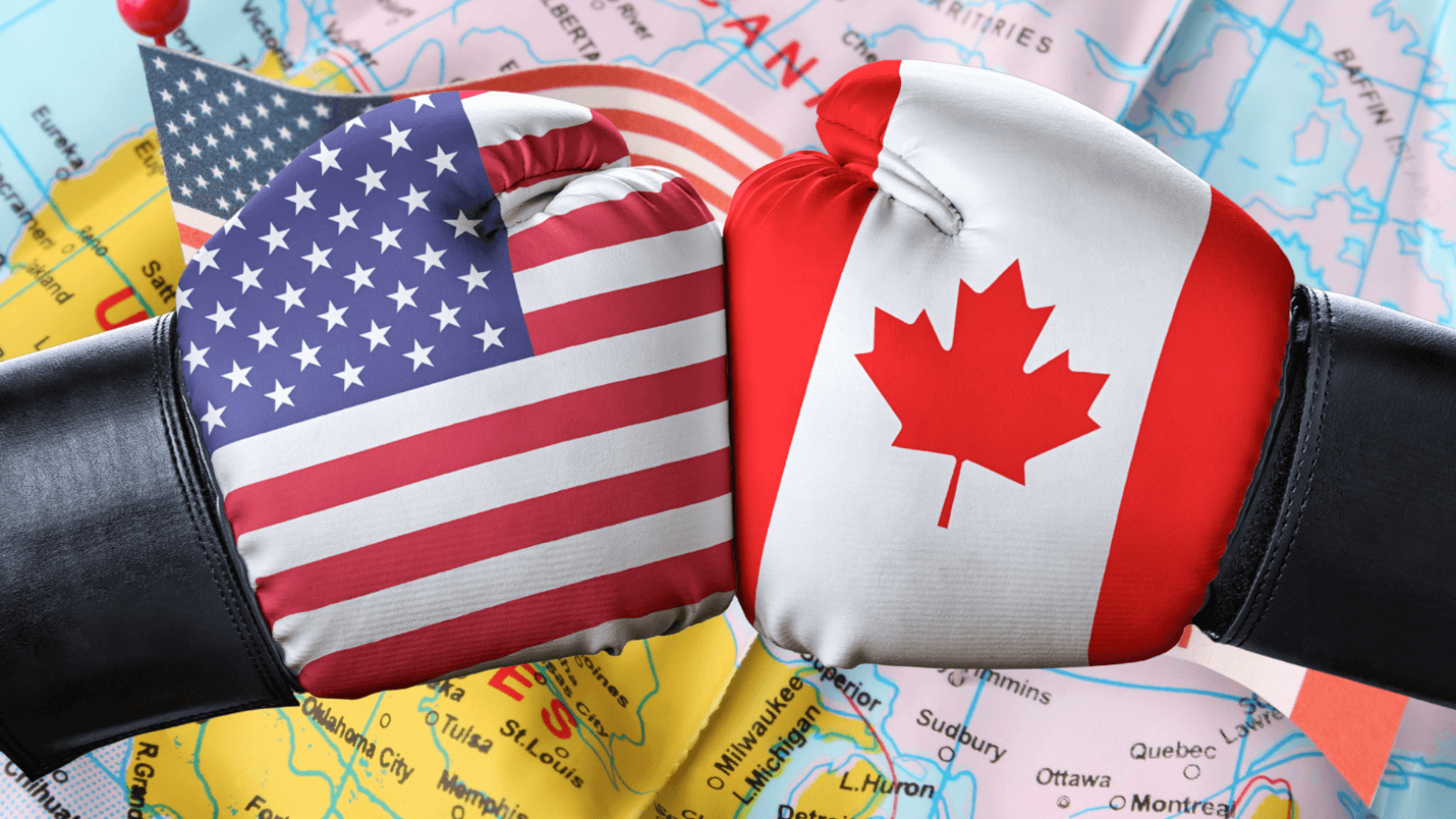

In a bold move that might not be in Canada’s best interest, Ontarians are backing their government’s tough talk against the United States. This comes after Ontario’s Premier threatened to retaliate against President Trump’s new tariffs on Canadian goods, pledging “We’re Gonna… Inflict as Much Pain as Possible on The American People.” Canadians are cancelling trips to the U.S. in support, and Prime Minister Mark Carney has announced that the traditional U.S.-Canada relationship is over, receiving applause as a heroic figure. However, this sentiment may overlook Canada’s significant dependency on its southern neighbor.
The United States and Canada have long been intertwined through a robust economic partnership and collaborative defense agreements. Their extensive 5,500-mile shared border is a testament to their interconnected prosperity and security.
Following a recent cabinet meeting in Ottawa, Prime Minister Carney announced, “[The old relationship](https://edition.cnn.com/2025/03/27/americas/canada-trump-tariffs-response-latam-intl/index.html) based on economic integration and military cooperation is over.” This was in response to President Trump’s proposed 25% tariff on Canadian cars and parts—a move seen as a “direct attack” on the USMCA. Carney emphasized that the U.S. is no longer a reliable partner, and Canada will seek to “dramatically reduce” its reliance on the U.S., pivoting to allies such as France and the UK. The stage is thus set for a trade war, with Canada preparing for forceful retaliatory measures.
Canada’s economy is deeply entwined with the United States, its largest trading partner. In 2024 alone, approximately $600 billion in goods crossed the border, with total trade hitting $683 billion when services are included. Many Canadian provinces depend on the U.S. for 55% or more of their exports. Nationally, U.S. trade accounted for 16.8% of Canada’s GDP in 2023, with vital commodities such as oil, natural gas, and minerals flowing south.
Moreover, the economic ties are reinforced by foreign direct investment (FDI). In 2024, U.S. FDI in Canada amounted to roughly $58 billion, making up about 45% of Canada’s total FDI. Canadian FDI into the U.S. totaled $69 billion in 2023. Foreign companies often invest in Canada to take advantage of tariff-free exports to the U.S. under agreements like the USMCA. However, if U.S. tariffs increase, such investments are likely to diminish, impacting Canada’s economy significantly.
In response, the Canadian government set up a $4.8 billion USD fund to aid businesses affected by the anticipated loss of U.S. exports. Unfortunately, this fund represents a hefty tax burden without generating income, covering only 1% of the vast $438.5 billion USD trade with the U.S.
Looking to Europe and other nations as new trading partners won’t fill the void left by the U.S., the world’s largest export market. Canada already trades with 190 countries, and asking these partners to increase their imports is unrealistic. Additionally, higher shipping costs make these exports less competitive compared to trade with the U.S. Moreover, other countries would demand more imports, turning Canada’s current trade surplus into a potential deficit.
Beyond economics, Canada’s defense strategy heavily relies on the U.S. Canada benefits from U.S.-led Five Eyes intelligence and relies on American military strength, especially through NORAD, to secure its borders. Given the increasing threats from Russia and China in the Arctic, Canada’s smaller military force (68,000 personnel) is no match compared to the U.S. military’s 1.3 million members and its $900 billion USD defense budget.
In conclusion, while Canadians might rally behind the rhetoric of independence, the reality is that Canada fundamentally relies on the United States for its economic and defense stability. Severing these ties could be more detrimental to Canada than beneficial, with Canada being far more dependent on the U.S. than the reverse.